Thursday, 6 October 2011

Groceries

I thought it would be interesting for all of you to read about the groceries. No! Japanese do not sell only rice and sushi. There is a big range of western-syle food, many French bakeries in supermarkets and at a train stations, and a lot of western sweets. The are certain differences. For example, they sell yoghurt plain, without any fruits or other additives. The sizes of all that you buy are two times smaller than the ones we're used to in Europe. The biggest chocolate you could buy in a nearest store would weigh arround 100 grams, bread is sold in a packages with 6 realy large slices, müesli is in a package of 425 grams.

The only thing they sell in a realy large package, is rice. Rice is usually sold in 2-3 kilo packages, and would cost around 2000 yen, which is realy expensive, compared to Europe.

The least thing, I expected, is that Japan has a realy small variety of fruits. The most of them are a lot bigger, then we're used to, and also a lot more expensive. I put a phone besides those two, so you could see, how big they actually are.


So, this one apple costs 100 yen, and the other fruit (I have no idea, what it is. It has a shape of peach, the texture of a pear, and it tastes like pear and orange combined.) was 150 yen. And they were discounted. Usually, the yellow fruit costs about 300 yen.

On the other hand, there are a lot of vegetables. I have never seen so many different kinds of mushrooms in a supermarket! All vegetables are cheaper then in Europe, and there's much more to choose from.

I mean it !!!


Schools and grading system

This is my second week of school now. In Japan a school year begins in April with a Summer holiday starting in mid-July. The second semester begins in late September, with the last exams in the beginning of February.

So, compared to Denmark, the attendance in the university is compulsory. If you're late or not attending 4 or more lectures without any reason, you'll automatically get a D. Grading system resembles the universal one, with A, B, C, D grades. Sometimes, there is an S grade, which stands for excellent, remarkable. Therefore, a D would mean that you have failed a subject.

For most of my subjects a grading system looks like this:

I don't mind. It's certainly more fun to attend more classes and participate in discussions; the most of the lecturers encourage us to tell them our own opinion.

Furthermore, there is no dress code in Rikkyo University. You can dress as you like. Though, I think, most of the people dress up to the ethical standards of the country.

Almost all elementary, secondary and highschool students wear uniforms, and sometimes the rules are even stricter, such as: you cannot dye hair, use any decorative cosmetics or nail color.

Tuesday, 4 October 2011

How to live in a metropolis 2

We were recently in one of the skyscrapers in Tokyo, in Shinjuku area. Seeing the view from the 45th  floor reminded me of Aarhus. With one HUGE difference - from the suburb, I live in, you can see the whole town from:


If you look closely, the white tower, you can see on the horizon - it's the city hall, the center of the city, only 5 minutes walk from the pier. I love living in Viby, it's a nice area, and the night view is just fantastic.

But it is no match for this:


There aro no words to describe the feeling, when you're looking outside the window, and all you see are buildings - until the horizon, no matter from which side do you look.

It's even more impressive to stand beside a skyskraper, and looking all the way up. The head starts to spin, and you realize, how small you are and how powerful a man's hand can be.


Sunday, 2 October 2011

How to live in a metropolis

Could you imagine yourself living in a city, where's not a lot of space, the most parks are a train ride away? Possibly, you wouldn't have a space to have a pet. There's been found a great solution to the problem here, in Tokyo. It's so-called Cat-caffés. Rules are simple - you come inside the caffé, play with a cat or two, or three, or as many, as you like, while drinking some coffee, soda, juice, etc. Or you can enjoy your drink sitting by the table, eating snacks and looking through the albums with the pictures of the caffé's pets. These were just so cute:


Language

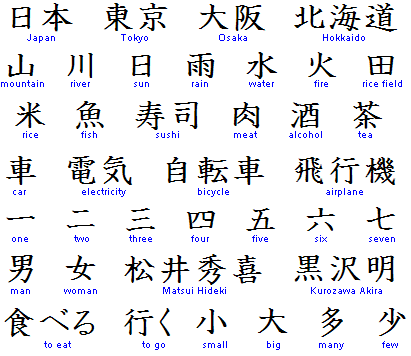
There are 3 different alphabets in Japan: katakana, hiragana and kanji. Katakana is used to spell the foreign words, like these:


Hiragana is the simple language. It's possible to spell everything in hiragana, but it would be hard to distinguish the words, as in Japanese you do not use space between the words. Therefore, hiragana signs can be joined to kanji, like these:


Hiragana is mostly used for a suffix of the word.

RUID Dorm

Some exchange students have a possibility to live in the university's dormitory. Rikkyo University has it's dormitory in Saitama, it's about 20 minutes ride on the train to Ikebukuro. Not so far away, as I first thought, and considered to buy a bicycle. They are quite cheap here, you can buy a new one for about 10,000-20,000 yen. But in reality, there are approximately 17 km between the two stations, so I decided to stick with the train.


This is how the room looks like:


- Why does the toilet look so weird? -The toilet seat is heated, if you turn it on. It does a lot of other things, which I do not know a thing of, because I do not read Kanji.